Recognize clean execution.
Reward correct scans, valid quantities, complete proof, accurate counts, correct labels, and fewer avoidable corrections.
AJAX Gamification is designed to turn real operational behaviour into visible progress without rewarding reckless speed. It can support training completion, accurate scans, timely exception cleanup, quality participation, clean handoffs, and safe throughput across enabled applications.
AJAX Gamification is intended to use actual training, warehouse, quality, logistics, EDI, messaging, and cleanup records to support coaching, recognition, and participation in cleaner execution.
Reward correct scans, valid quantities, complete proof, accurate counts, correct labels, and fewer avoidable corrections.
Make assigned, completed, current, overdue, and renewed training visible without treating attendance alone as operational performance.
Highlight timely resolution of blocked pallets, missing labels, count differences, holds, rejected documents, and other approved exceptions.
Use completed work together with accuracy, safety, quality, proof, and correction rates instead of ranking users by transaction count alone.
Recognize required images, notes, signatures, acknowledgments, inspections, handoffs, and supporting evidence where configured.
Surface repeated errors, incomplete training, overdue exceptions, frequent corrections, or workflow-specific difficulty for supervisor review.
Use location, shift, role, application, or workflow targets that promote collaboration rather than hiding problems to protect an individual score.
Show progress, badges, milestones, acknowledgments, or other configured recognition without representing the score as payroll or disciplinary evidence by default.
The source work, validation, signal, supervisor review, and final recognition or coaching action remain connected.
Use completed AJAX OES work such as scans, inspections, training, cleanup, proof, handoffs, and corrections.
Confirm that the work was permitted, complete, accurate, timely, and not reversed, rejected, or under review.
Apply configured points, progress, completion, quality, participation, or coaching indicators.
Let supervisors review context, exceptions, reversals, missing evidence, and unusual patterns before acting.
Use the result for progress, acknowledgment, team goals, refresher training, support, or process improvement.
A fast transaction is not valuable when it creates a later correction, quality problem, missing proof, unsafe shortcut, or customer dispute. AJAX Gamification is intended to keep speed in context.
Users can review assigned goals, completed training, clean work, open coaching items, milestones, and recognition permitted by the tenant.
Use shift, location, department, or workflow goals for cleanup, readiness, quality, proof, and service without encouraging users to compete unsafely.
Review the underlying work, reversals, context, training, assignment, exceptions, and data quality before using performance signals.
Each tenant can choose which activities are appropriate to measure and how those indicators should be weighted.
| Signal Area | Operational Context |
|---|---|
| Accuracy | Correct item, lot, SSCC, quantity, bin, document, label, inspection, and proof completion. |
| Quality | Passed validation, complete evidence, approved disposition, fewer repeated defects, and timely holds. |
| Timeliness | Completed work, aging exceptions, response time, readiness, overdue training, and required follow-up. |
| Safety and Policy | Required acknowledgments, approved process, restricted actions, escalation, and documented compliance steps. |
| Corrections | Reversals, recounts, relabeling, repeated errors, incomplete proof, rejected documents, or reopened work. |
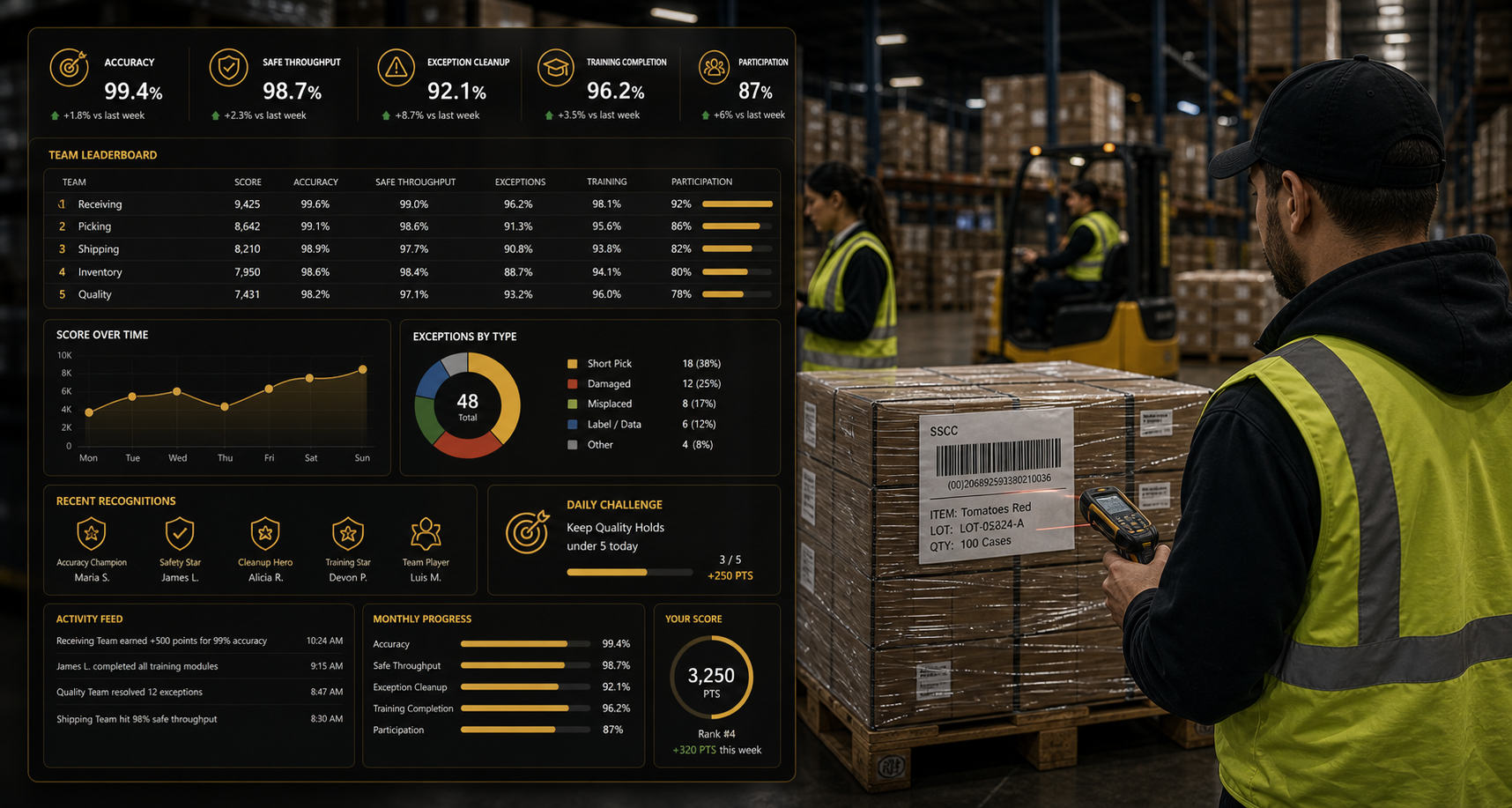 Accuracy and Cleanup Dashboard
Review training, completed work, correction rates, exception aging, proof completion, quality signals, and team progress with operational context.
 Coaching and Exception Cleanup
Connect the indicator to the actual task, workflow, recurring issue, training content, supervisor note, and approved improvement action.
AJAX Gamification is designed to work across enabled tenant applications rather than requiring a separate manual scorecard for each department.
Receiving, serialization, movement, picking, staging, shipping, counting, putback, relabeling, proof, and correction activity.
View WMSInspections, evidence, holds, releases, grading, claims, disposition, timeliness, and corrective action.
View QMSCheck-in, dock readiness, loading, temperature, documents, acknowledgments, delivery proof, and exception resolution.
View LogisticsResponse, escalation, shift handoff, assignment, acknowledgment, learning completion, readiness, and refresher activity.
View TrainingTimely receipt, grading, packout, settlement, approval, cost-review, claim, and exception workflows where appropriate.
View ProfitabilitySupervisors can review the source work, user, role, location, time, result, exception, correction, and applicable training before using the signal.
Scoring should consider corrections, quality, proof, training, holds, policy, and completion before recognizing transaction volume.
Role, shift, assignment, product, location, workflow, equipment, complexity, interruptions, and approved exceptions may affect results.
Supervisors should review source data, training, assignments, corrections, system conditions, and user explanation before employment decisions.
Each tenant should define which operational events may create a signal, how corrections affect the result, who may review the underlying data, how long records are retained, and how employees can question or correct inaccurate information.
Users and supervisors should be able to understand the measured event, weighting, exclusions, reversals, correction rules, and applicable review period.
Authorized reviewers can inspect source activity, assignment context, system issues, approved exceptions, corrections, and supporting evidence before acting.
A score should not silently become payroll, discipline, termination, safety, or legal evidence without separate policy, review, and compliance controls.
Use operational evidence to make meaningful progress visible, focus coaching, and reduce spreadsheet-based evaluation.
Users can see training, quality, cleanup, proof, readiness, and shared operational goals instead of receiving only negative feedback after a problem.
Supervisors can use recurring exceptions, corrections, missed steps, and training gaps to focus coaching where it is needed.
Performance signals can come from completed AJAX OES work, reducing spreadsheet updates and memory-based evaluation.
Estimate AJAX OES pricing, create a tenant, and begin guided setup without waiting for a consultation.
AJAX Gamification capabilities shown on this page describe the intended operational-engagement application and may include planned features.
Final availability and scope depend on enabled applications, tenant configuration, data quality, user roles, measurement rules, privacy and employment policies, labour agreements, applicable law, supervisor review, and implementation requirements. Performance signals should not be used as the sole basis for compensation, discipline, termination, safety, or other high-impact employment decisions. Customers remain responsible for appropriate notice, policy, consultation, review, and legal compliance.